دايرتنا · Da'eratna
Bilingual mental wellness platform across web and mobile
10 min read
- Role
- Lead Product Designer (with one junior designer)
- Timeline
- 2026
- Platform
- Web (Vue) + Mobile (Flutter)
- Surfaces
- 4 — Provider (web + mobile) · Participant (web + mobile)
- Status
- Design system shipped, in development
A four-surface platform — provider and participant, on web and mobile — built on a system-first approach. Single design system serving 8 contexts (2 languages × 2 platforms × 2 modes). Lead designer working with one junior designer.
The opportunity
Mental health platforms in the Arab world face a unique constraint: clinical language carries stigma, but vague language carries liability. Da'eratna was built around a cultural insight — Arabic speakers seek support for emotional struggles long before they're willing to use medical terms.
I started with the design system, not the features. Before designing a single screen, I built a foundation that supports two languages (Arabic, English), two platforms (desktop, mobile), and two color modes (light, dark) — eight contexts for any single component.
This let one junior designer ship the web portal under my review while I own mobile (Flutter) end-to-end. We work in parallel on the same features without colliding because the system carries the consistency, not us.
The hardest problem: designing a system that serves real psychological care without ever calling itself one. Every screen, every label, every notification had to walk the line between accessibility and clinical responsibility — across all eight contexts.
Context
Da'eratna ("our circle" in Arabic) is a wellness platform for the Saudi and Egyptian markets. Providers — coaches, psychologists, counselors, peer leaders — use it to create and run support "circles" focused on specific emotional themes (anxiety, grief, parenting, life transitions).
Inside each circle, providers can run one-time sessions, ongoing weekly sessions, structured programs over multiple weeks, or workshops with registration tiers.
Both providers and participants have full access to the platform on both web and mobile — they choose where they want to work.
The product makes one cultural decision that shapes everything else: the platform's user-facing language avoids medical terminology. A circle is "دائرة القلق" (the anxiety circle) — not "anxiety treatment". A session is "جلسة" — not "therapy". This isn't softening; it's a deliberate boundary.
Medical terminology only surfaces inside the provider's own private workspace, where it belongs to their clinical responsibility, not the platform's.
System first, features second
Most projects start with feature design, then extract a system later. Da'eratna started the opposite way: I built the system before designing a single user-facing screen.
The reason was practical. The product had to ship in eight contexts:
Languages × Platforms × Modes — (Arabic, English) × (Desktop, Mobile) × (Light, Dark) = 8
Designing each feature eight times wasn't realistic — not with one junior designer and an active development team waiting. The system had to do the heavy lifting.
Foundation tokens defined semantically
Color, typography, spacing, motion, and elevation — defined as semantic tokens, not raw values. Tokens reference each other so a single variable change cascades correctly across all eight contexts.
Bilingual typography pairs
Two type systems that match in weight, rhythm, and density. Switching languages doesn't change the perceived information density of the screen — a small but critical detail in bilingual products.
Mode-aware components
Every component was designed in light and dark from the start, not retrofitted. Dark mode in mental wellness products matters more than people realize — many participants use the app at night, and the wrong contrast values make late-night reading feel clinical instead of calming.
Platform-adaptive patterns
Components know which platform they're on. A modal on desktop becomes a bottom sheet on mobile. A data table on desktop becomes a card list on mobile. The system handles this translation, not the designer.
Four landing themes — narrowed to one
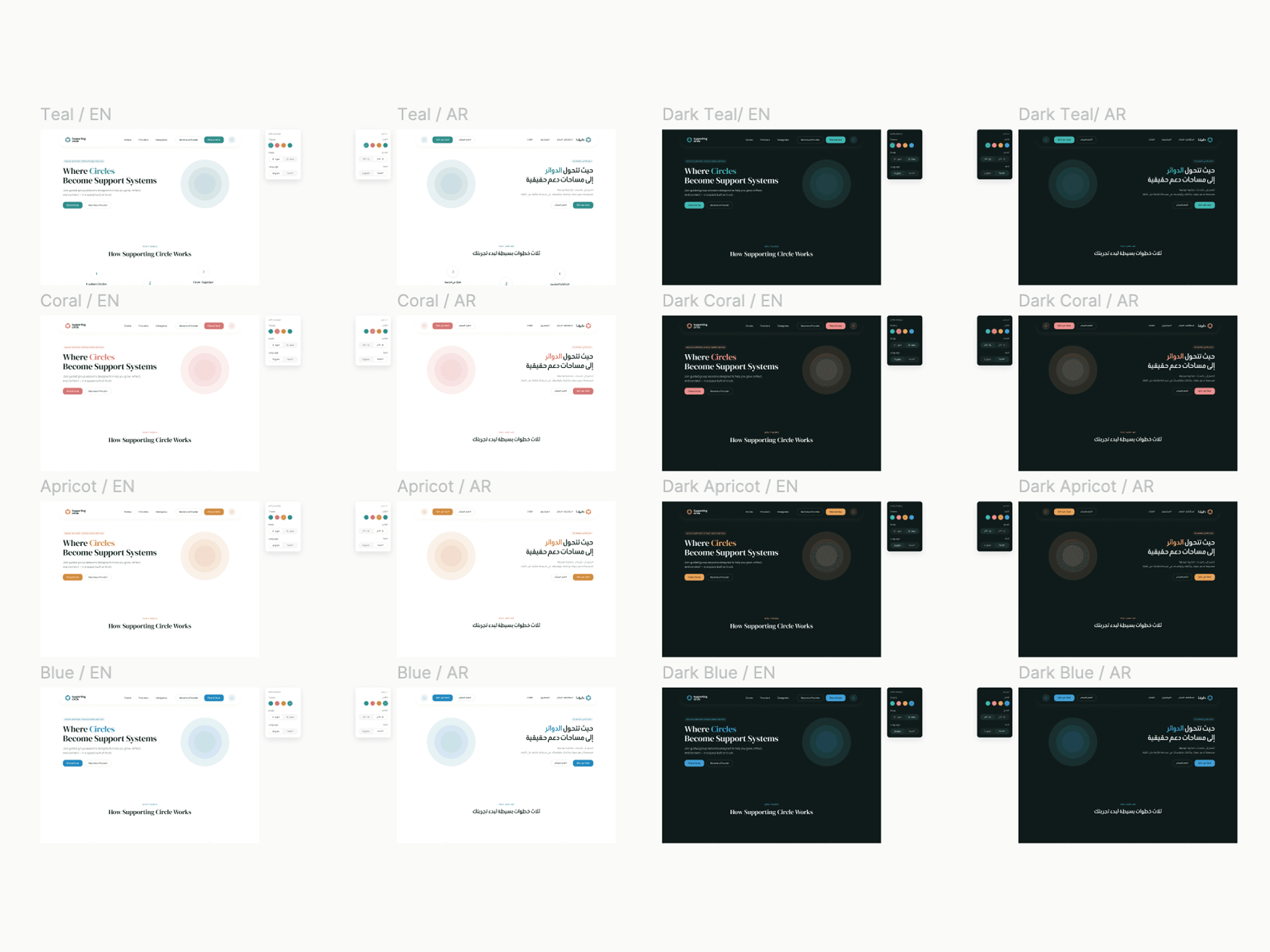
Before we settled on the platform's visual identity, I explored four distinct landing-page directions across both desktop and mobile (eight artboards each). The team chose one direction. The other three weren't waste — they defined the visual boundaries of what the brand wasn't, which made the chosen direction defensible.
With the system in place, the team could split: I own mobile (Flutter) — provider and participant; the junior designer owns web (Vue) — provider and participant. Both of us pull from the same components, the same tokens, the same patterns. Same feature, two surfaces, two designers — but one consistent product.
This is the workflow that lets a small design team ship a four-surface product. Without the system-first approach, we'd be a bottleneck instead of a team.
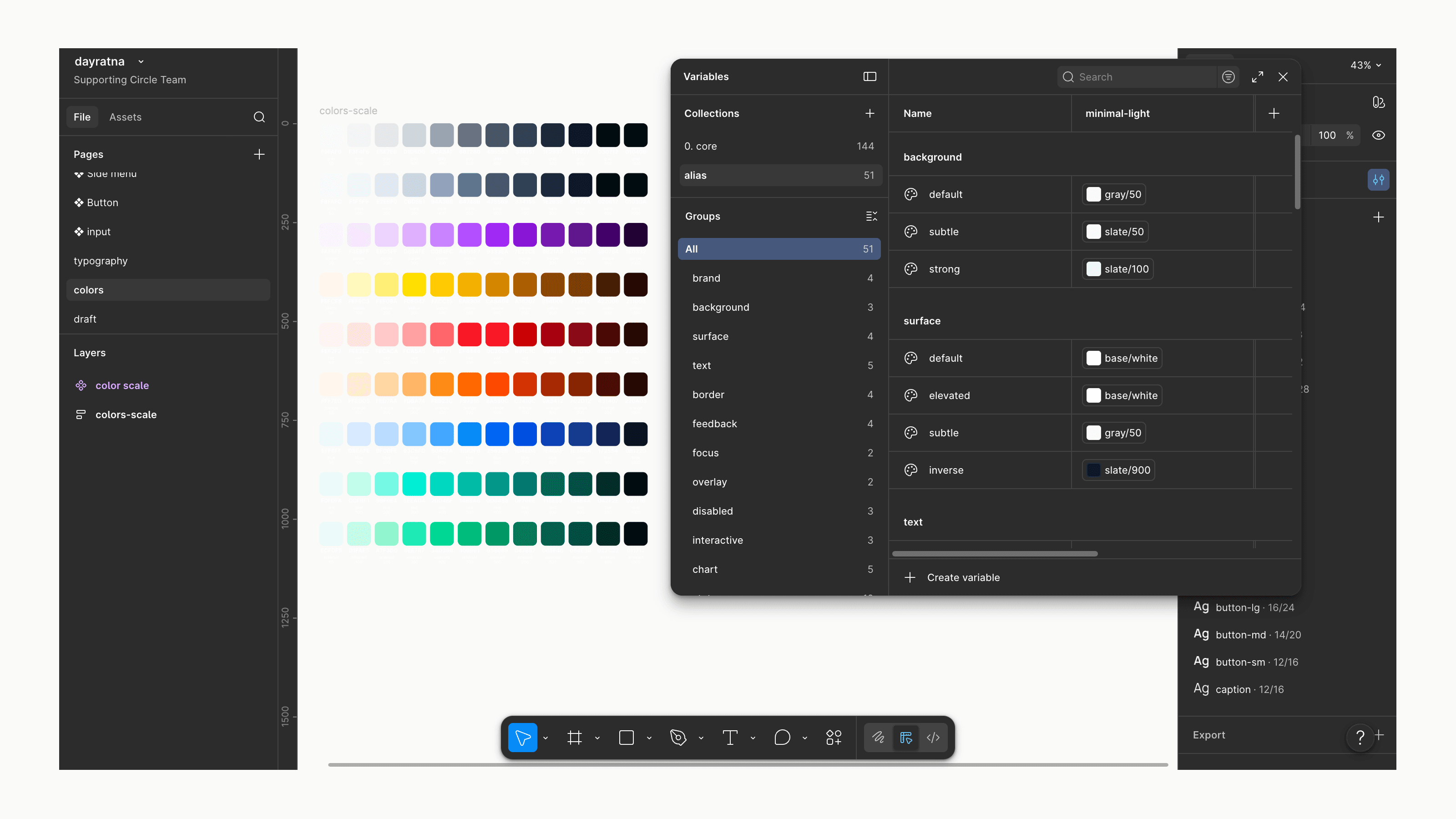
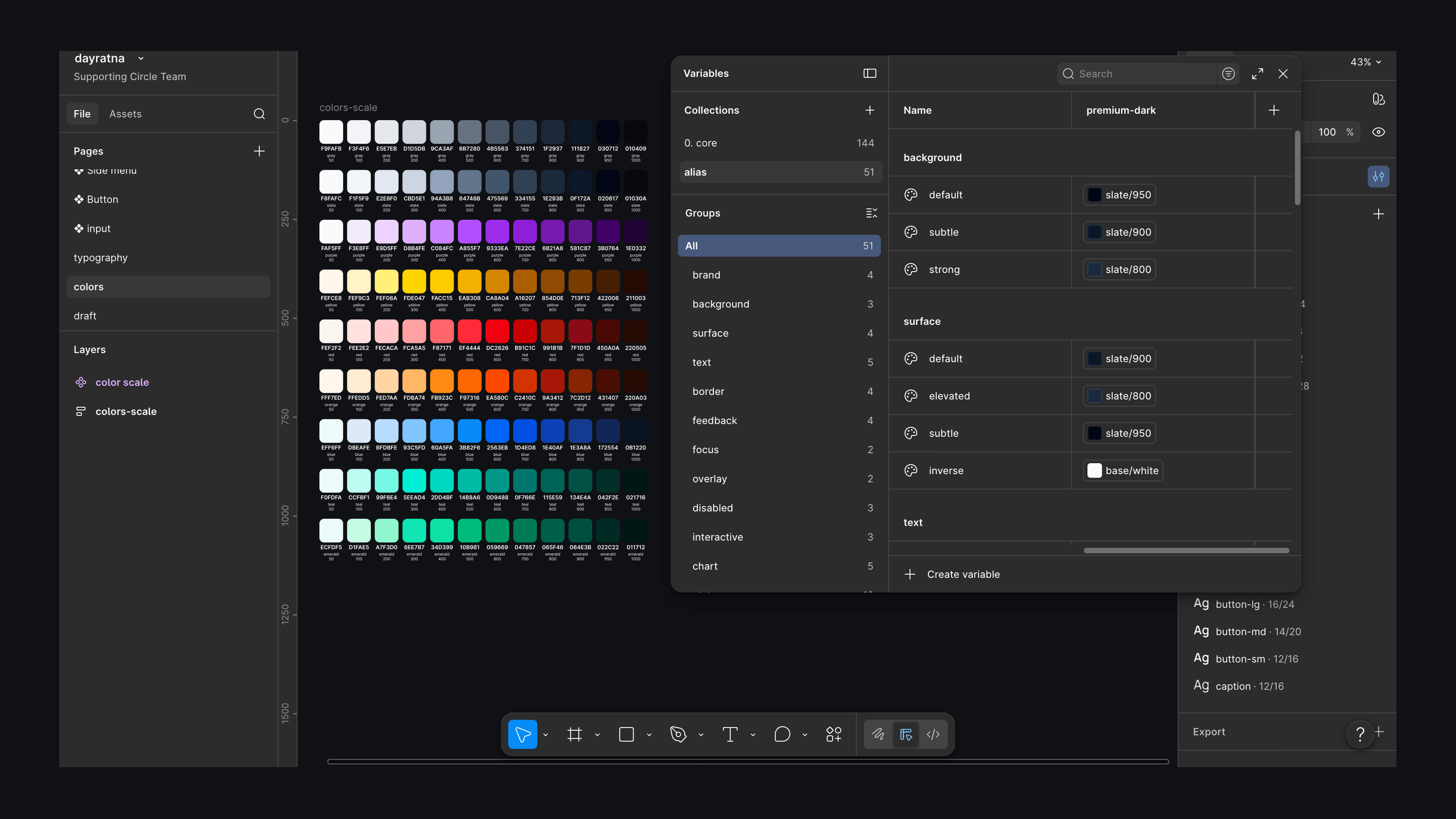
Semantic tokens cascade across light and dark modes
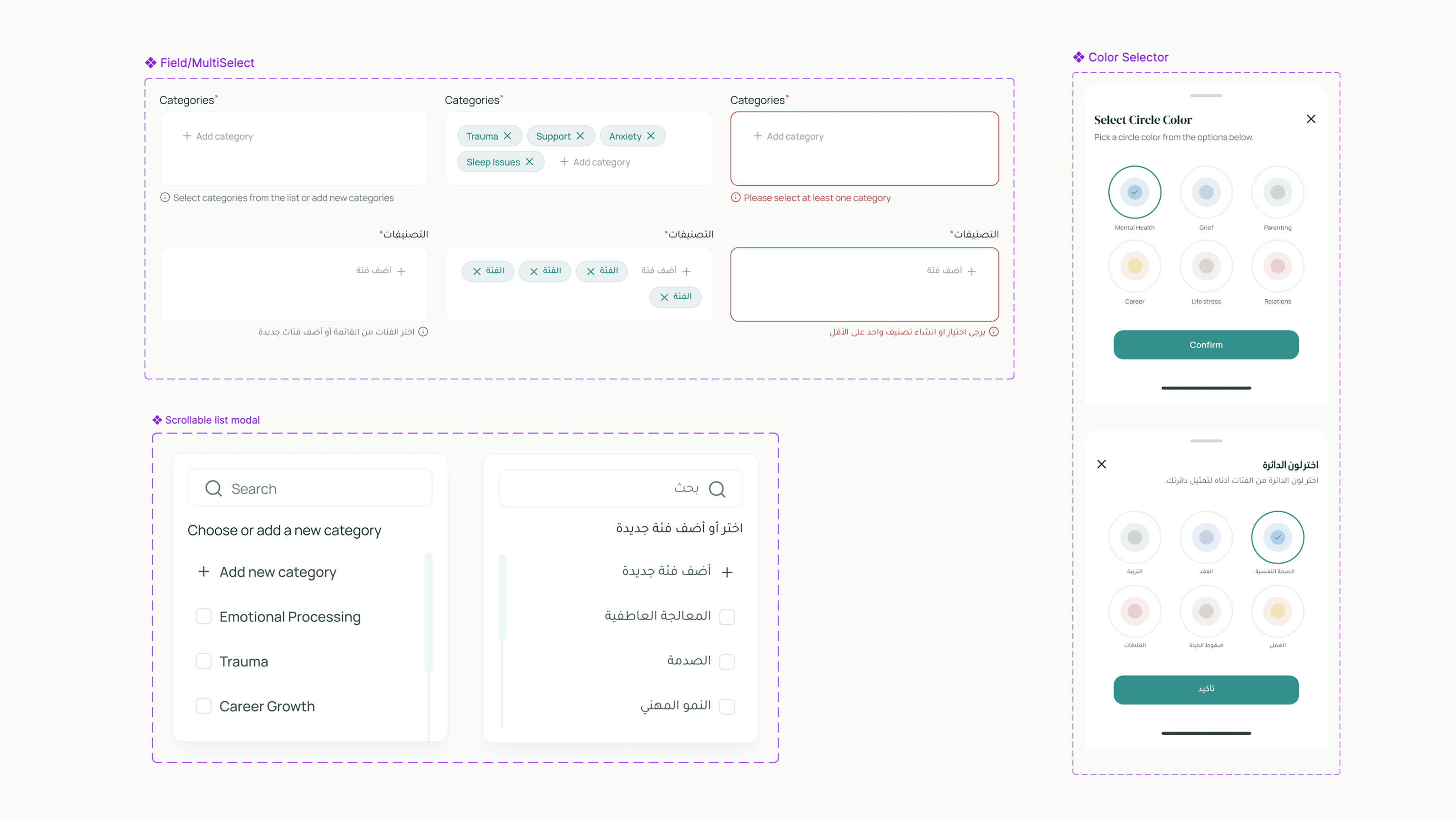
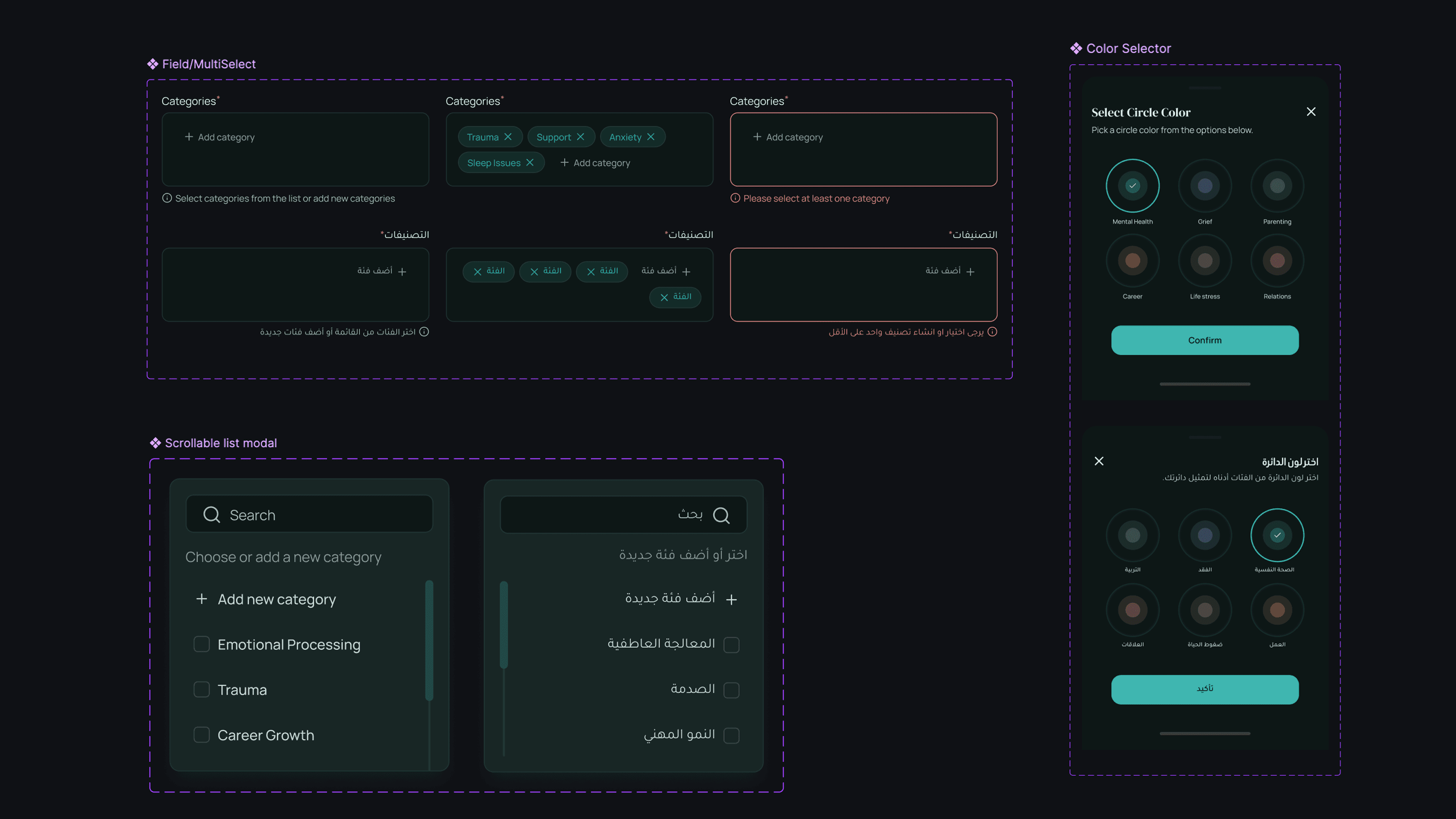
One component, two languages, identical rhythm
The bilingual challenge
Most Arabic apps are designed in English first, then translated. The result is predictable: layouts that break under longer Arabic words, English numbers in Arabic dates, mirror-flipped icons that suddenly mean something different, and "RTL support" that's really just CSS direction reversal.
Da'eratna serves users in Saudi Arabia and Egypt — markets where Arabic isn't a localization, it's the primary language. Treating Arabic as a translation layer would have failed the product before it shipped.
Two languages, two layouts — never one mirrored
Arabic and English aren't mirror images of each other. Some elements (timestamps, numbers, icons) shouldn't flip. Others (text alignment, navigation flow, gesture direction on mobile) must. Instead of using a single auto-RTL flag, I designed each component twice — Arabic and English versions are siblings in the design system, not transformations of each other.
Numerals chosen by context, not by language
Arabic-Indic numerals (٠١٢٣) read more naturally in running Arabic prose. Western numerals (0123) are clearer in data-dense interfaces (schedules, prices, counts). The platform uses both — Arabic-Indic in content, Western in numeric UI elements like calendars and registration counts. This is a small detail that Arabic users feel immediately when it's done right and tolerate silently when it's done wrong.
Typography pairs that feel native, not adapted
English and Arabic each use a contemporary typeface paired in weight and rhythm — not just "an Arabic font that exists". I matched the visual density of both fonts so switching languages doesn't change perceived information density.
Bidirectional content handling
Mixed Arabic-English content (like English app names or Latin diagnostic terms when providers need them) is handled with explicit direction tags, not browser defaults. This avoided the common "phone numbers appearing reversed" bug that quietly affects most Arabic apps.
Gesture and motion language
On mobile, swipe gestures map to language direction. "Next" swipes left-to-right in English, right-to-left in Arabic — but progress indicators always advance forward visually regardless of language. Animations were designed in two directions, not flipped.
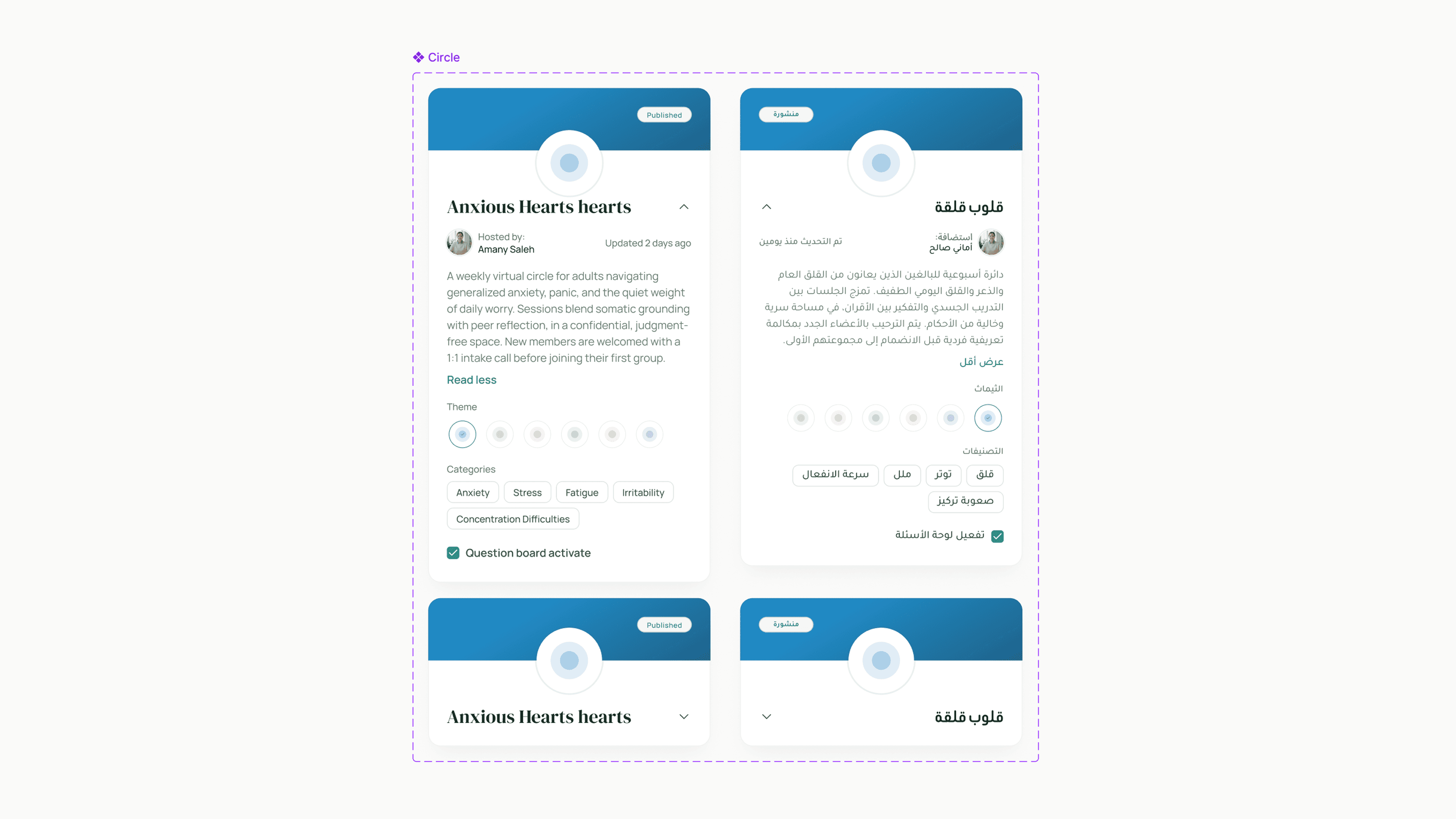
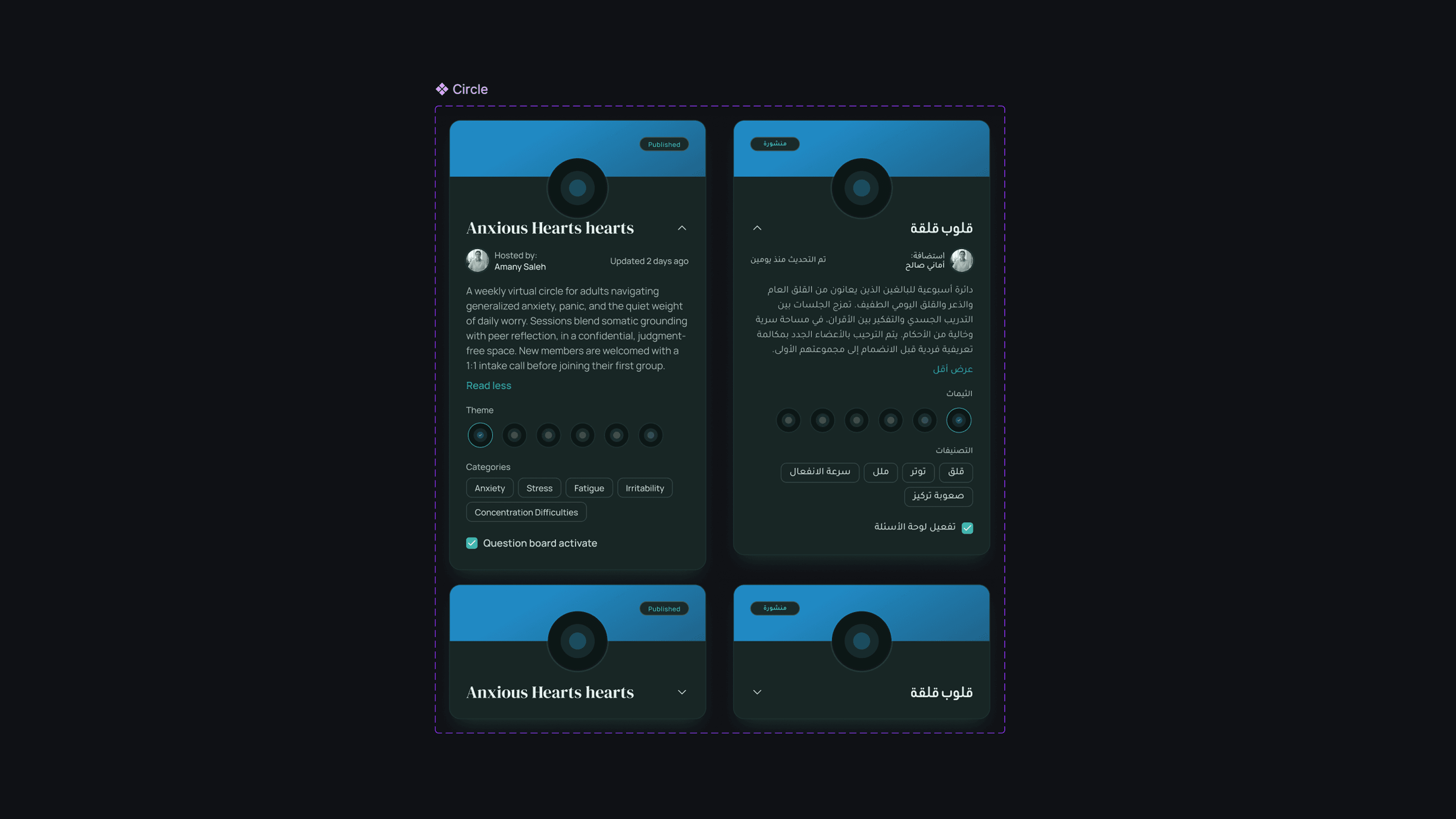
Arabic and English designed as siblings, not as a translation
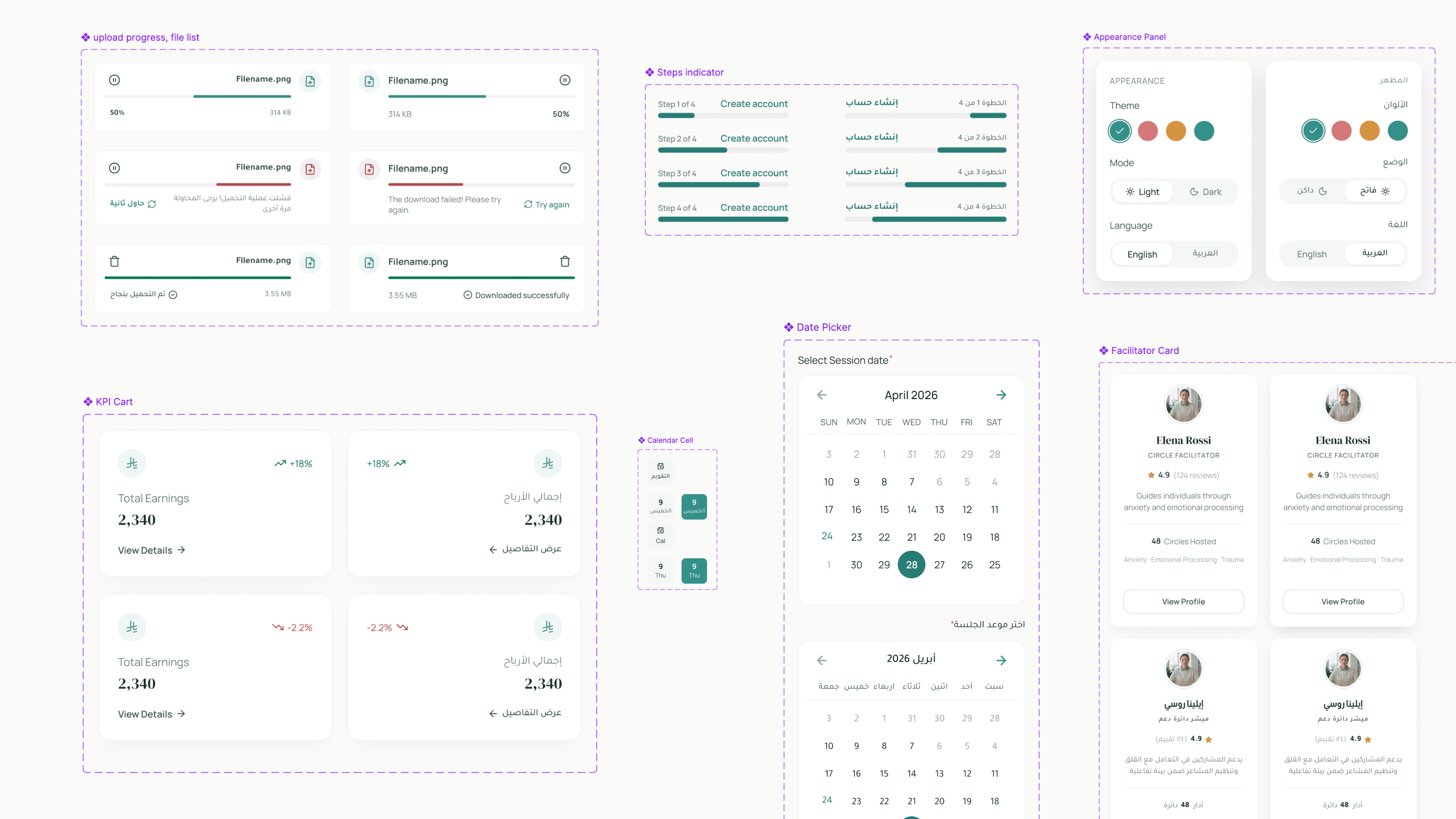
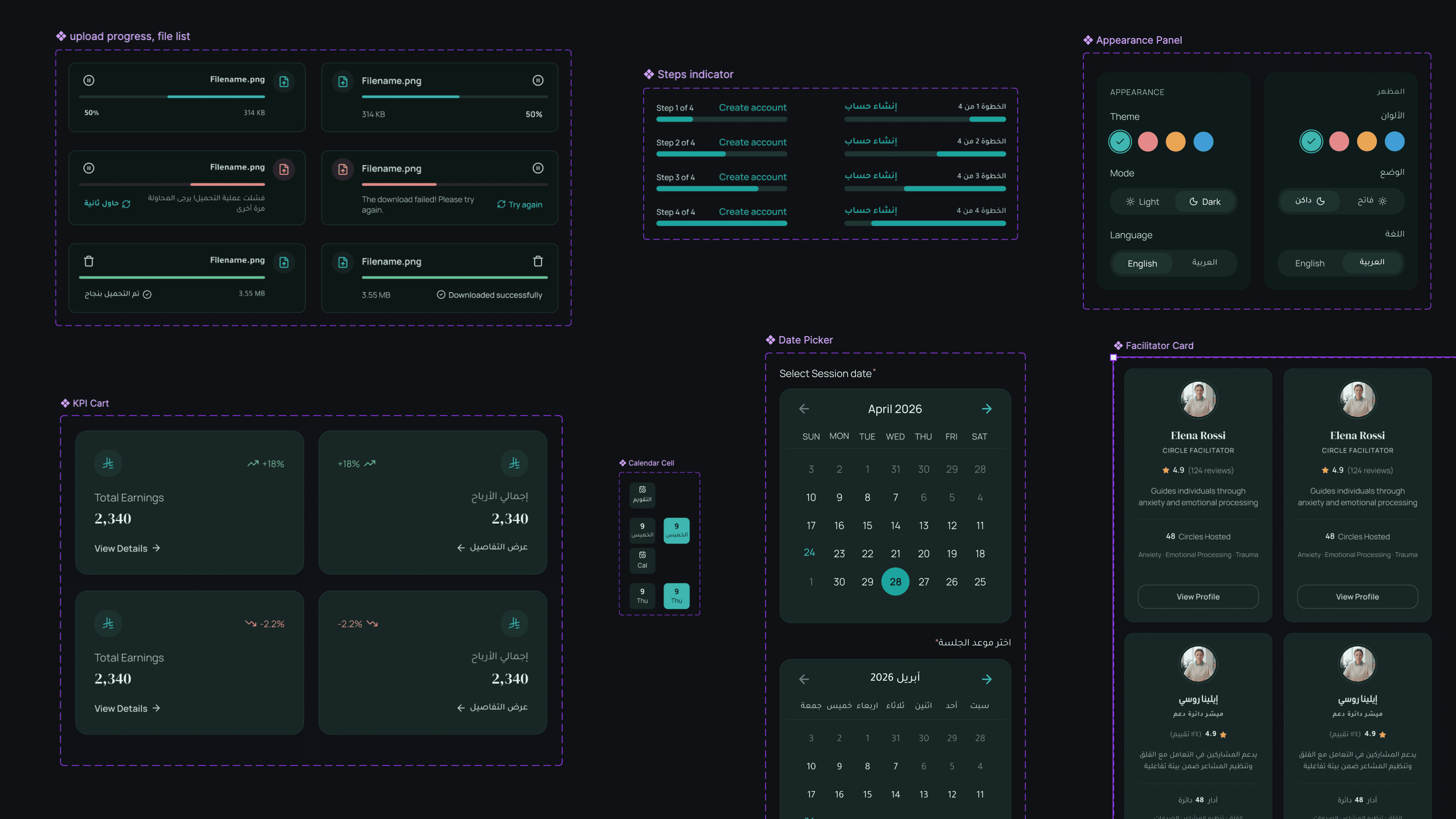
Numerals chosen by context, not by language
Cultural sensitivity in mental wellness
The non-medical language constraint shaped how the product talks to users. Saudi and Egyptian users searching for support don't type "I have anxiety" — they type "أحس إن قلبي مش مرتاح" or "تعبان نفسياً". The platform's content, discovery, and search had to respect that vocabulary.
Circles are emotional themes, not diagnoses
Browse categories use felt-language: "القلق" (anxiety/worry), "الفقد" (loss), "ضغط الحياة" (life pressure). Not "GAD", "MDD", or DSM categories. Providers can label their own circles internally with clinical terms; participants never see those labels.
Provider verification visible, not loud
Providers' credentials matter — but Saudi and Egyptian users are wary of platforms that feel "too clinical". I designed credential display to be discoverable on the provider profile but never the first thing a participant sees when browsing circles.
Provider-controlled language escalation
A coach running a "stress circle" might recognize a participant who needs clinical help. The platform allows providers — not the algorithm, not the platform — to escalate language privately ("I recommend you speak with a licensed professional"). This kept the platform's voice safe while empowering providers to do the right thing in context.
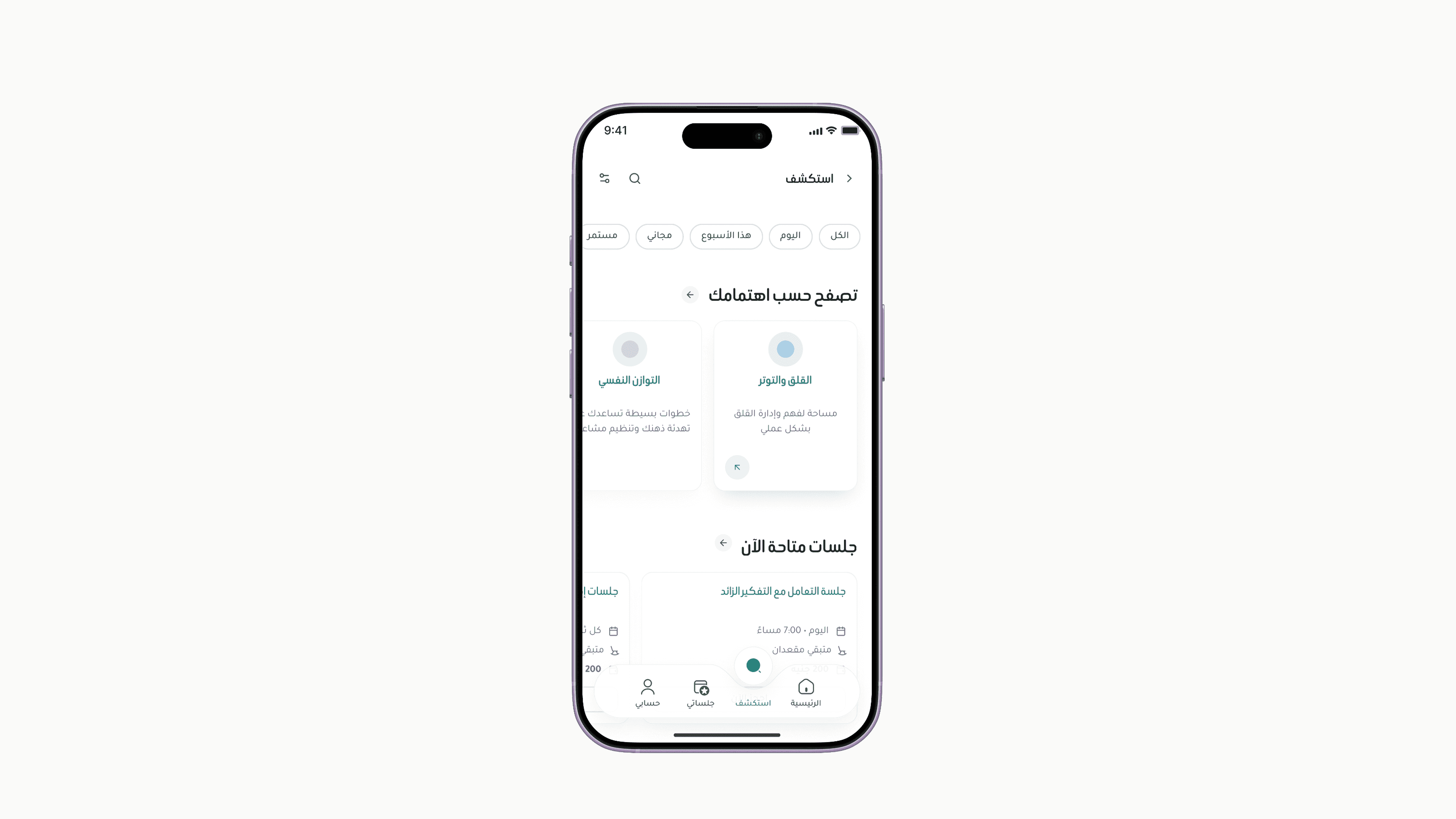
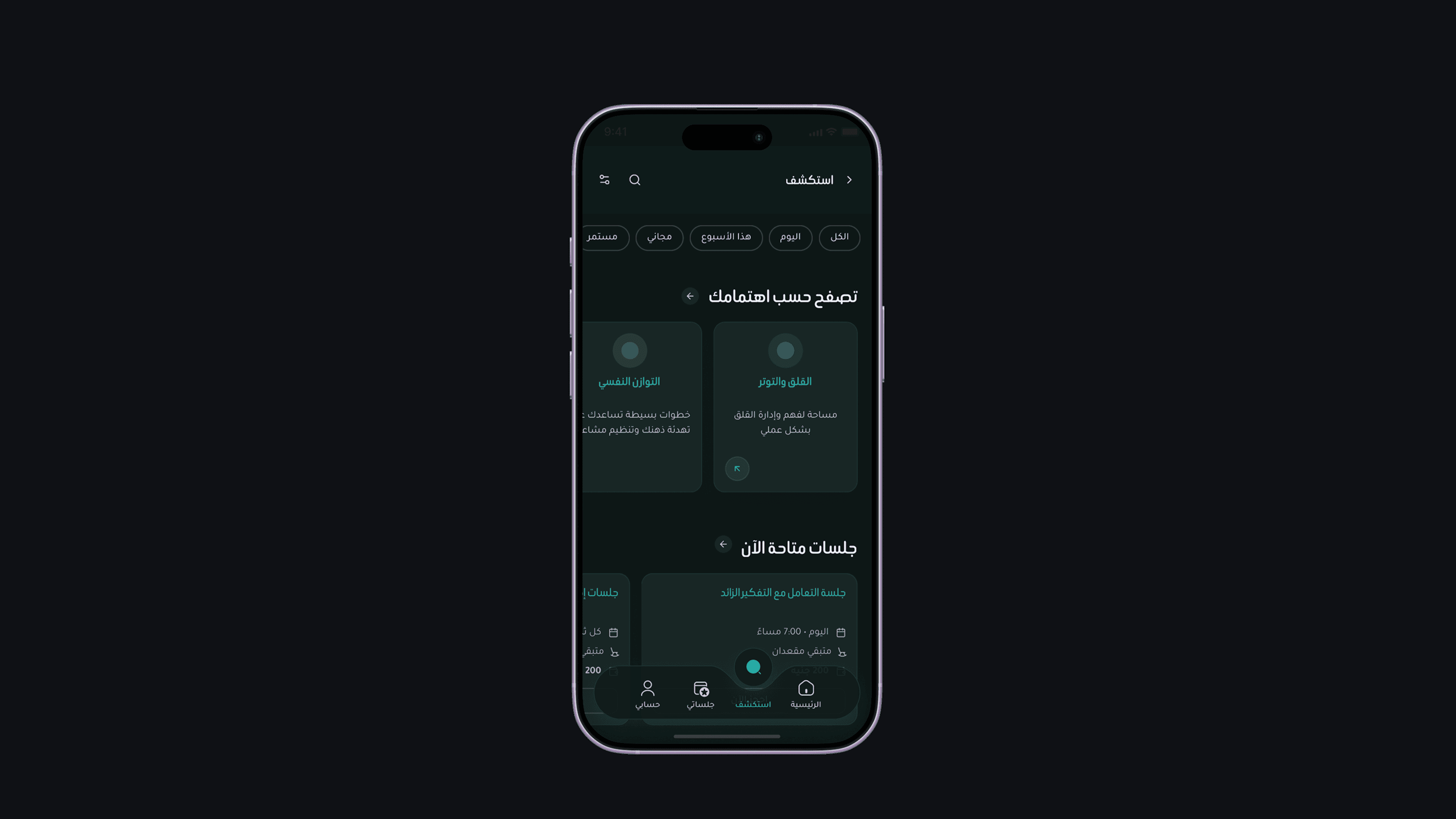
Browse by feeling, not by diagnosis
Design system: built for two languages, two platforms, two designers
I'm building this with a junior designer. I needed a system that supported both Arabic and English without doubling maintenance, worked across web (provider portal) and Flutter (participant mobile app), and was clear enough that a junior designer could ship features without me reviewing every spacing decision.
The system is structured in three layers. The foundation layer holds tokens, semantic naming, and strict reference rules. The component layer documents each component with both Arabic and English usage examples, plus edge cases (long Arabic strings, mixed content) shown explicitly so the junior doesn't discover them in production. The pattern layer captures common flows — registration, circle joining, session booking — as standardized patterns the junior composes from instead of redesigning each time.
In practice: she owns web portal screens; I review weekly. I own mobile (Flutter) end-to-end. Once a month we audit the system together — what's missing, what's broken, what needs revision. This split lets her grow ownership without overwhelming her, and lets me focus deep on the harder mobile interactions.
What I'd do differently
Documentation is design work
The system was good. The documentation was incomplete. The junior designer's first month was harder than it needed to be — not because the components were wrong, but because she had to ask me how to use them. The fix (better usage examples, explicit "do this not that" annotations, edge-case galleries) was design work I hadn't budgeted for.
Four landing themes was probably one too many
Exploring four directions felt rigorous at the time. Looking back, three would have been enough. The fourth exploration confirmed what I already knew from the first three. I'd cut earlier next time.
I'd involve a clinical consultant earlier
The non-medical language line is something I can hold, but I'm not a clinician. Twice we made copy decisions that a licensed psychologist later pushed back on — not because they were wrong, but slightly off in clinical implication. Earlier consultation would have saved two rework cycles.
Status
The design system is shipped and in active use. High-fidelity flows are complete for provider and participant — on both web and mobile. Mobile (Flutter) is in active development; web (Vue) is in late-stage build.
Pilot launch with selected providers in Saudi Arabia and Egypt is planned for 2026.
Specifics about the company, providers, and metrics are confidential. Available to discuss in interviews.